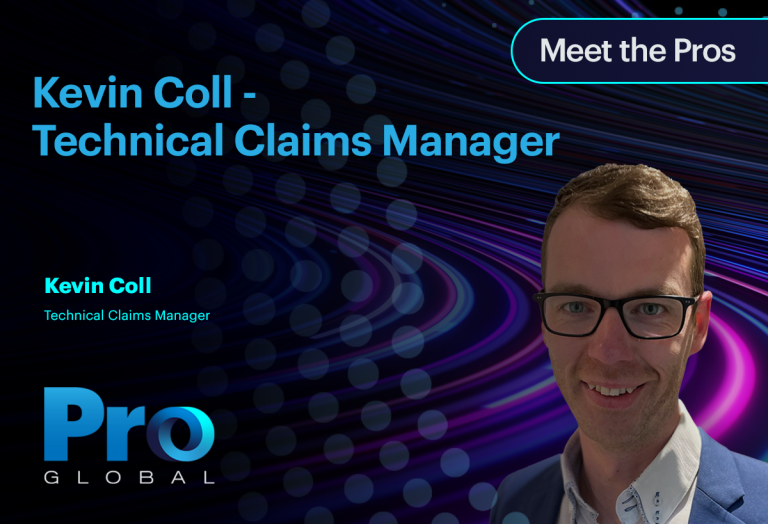
November last year marked a major milestone for Kevin Coll, who celebrated nine years at Pro Global as Technical Claims Manager. Kevin had been at Aviva since 2012 before transferring to Pro Global in 2016 through a TUPE as part of a re-insurance agreement, which at the time, was the biggest in the industry.
Today, he leads Pro’s Complex Claims team, managing several high-severity portfolios on behalf of major insurers and reinsurers. Over the years, Kevin has developed deep expertise in asbestos-related disease claims, an area known for its technical, legal, and evidential challenges and severity portfolios on behalf of major insurers and reinsurers.
In the UK, asbestos claims for compensation were made by individuals or their families if said individual developed an asbestos-related disease, such as mesothelioma or asbestosis, through negligence. The volume of claims in this area is still an ongoing issue due to the delay between exposure and symptoms.
The very first documented death due to asbestosis was reported in 1924 of a 33-year-old woman who had worked in an asbestos textile factory. Later, in 1967 the very first personal injury claim for asbestos-related illness was issued in the UK, then in 1972, the first successful asbestos-related disease claim was brought at the House of Lords.
We caught up with Kevin to discuss the fascinating topic of asbestos claims for those that have developed an illness resulting from exposure to the substance. We asked him how he has seen these complex and often long-tail claims develop over the years…
What are the challenges associated with investigating an asbestos related claim?
There are various factors, which can make an asbestos-related claim challenging to investigate such as investigations into historical coverage records or policyholders to ensure the entity being pursued was the individual’s employer.
As well as undertaking investigations into policy coverage, investigations into breach of duty can be problematic due to the passage of time between an individual’s exposure and the claim being intimated. Documentation and records are no longer available, premises no longer exist and witnesses are untraceable or in some cases, deceased. In some scenarios, we cannot even trace the employing entity as they were sole traders and not a Limited trading company.
How do insurers determine liability when exposure spans multiple employers and years?
Exposure histories are rarely straightforward. Many individuals worked across multiple employers, roles, or industries over decades. Investigations will determine whether negligent exposure occurred during the periods of cover. These investigations can also be used to determine – if and when – the exposure ceased to apply a cut-off date.
In many cases, numerous compensators can be involved. Liaising with those parties is key to determine respective contributions to the claim. An overall co-ordinator is usually identified who will lead discussions with the injured parties Appointed Representatives (AR), to negotiate settlement, should liability be accepted by those parties.
How do claims vary by jurisdiction?
Asbestos-related claims differ significantly depending on the legal framework, compensability rules, and court precedents in each jurisdiction. These variations affect whether a claim can be brought, what damages may be awarded, and which law applies when exposure or employment spans multiple regions.
The most notable distinction is that pleural plaques are not compensable in England and Wales whereas it is for Scotland & Northern Ireland.
Scotland has more generous damages framework which includes Loss of Society on a fatal claim. This allows multiple individuals with a familial relationship to bring their own claim whereas in England and Wales, this is called a Bereavement Award and is a fixed statutory amount awarded to a restricted group of individuals, normally the spouse or civil partner. This generally means a claim brought in Scotland is more valuable than those brought in England and Wales.
What are the ethical considerations for insurers when settling claims for terminal illnesses caused by asbestos?
When dealing with a claim for a terminal illness, we always embed the principles of Treating Customers Fairly. Nobody would ever want to be in a position where they are told they have a terminal illness and you have to take a sympathetic approach when dealing with these claims. We are trying to achieve the best possible outcomes for all parties involved in the matter, with as little impact upon the individual as possible. We try to obtain as much information from them as early as possible to allow them to continue living their life whilst we assess the information and come to an informed decision.
With developments in cancer treatments, particularly in immunotherapy, as part of settlement negotiations, we fund treatment for individuals which improves their quality of life and extends their life expectancy.

Meet our expert
Name: Kevin Coll
Job title: Technical Claims Manager
Get in touch
To speak to the Pro Global team please feel free to reach out to us at:


Lysander PR
To contact our PR team directly please use the link below

 View Previous