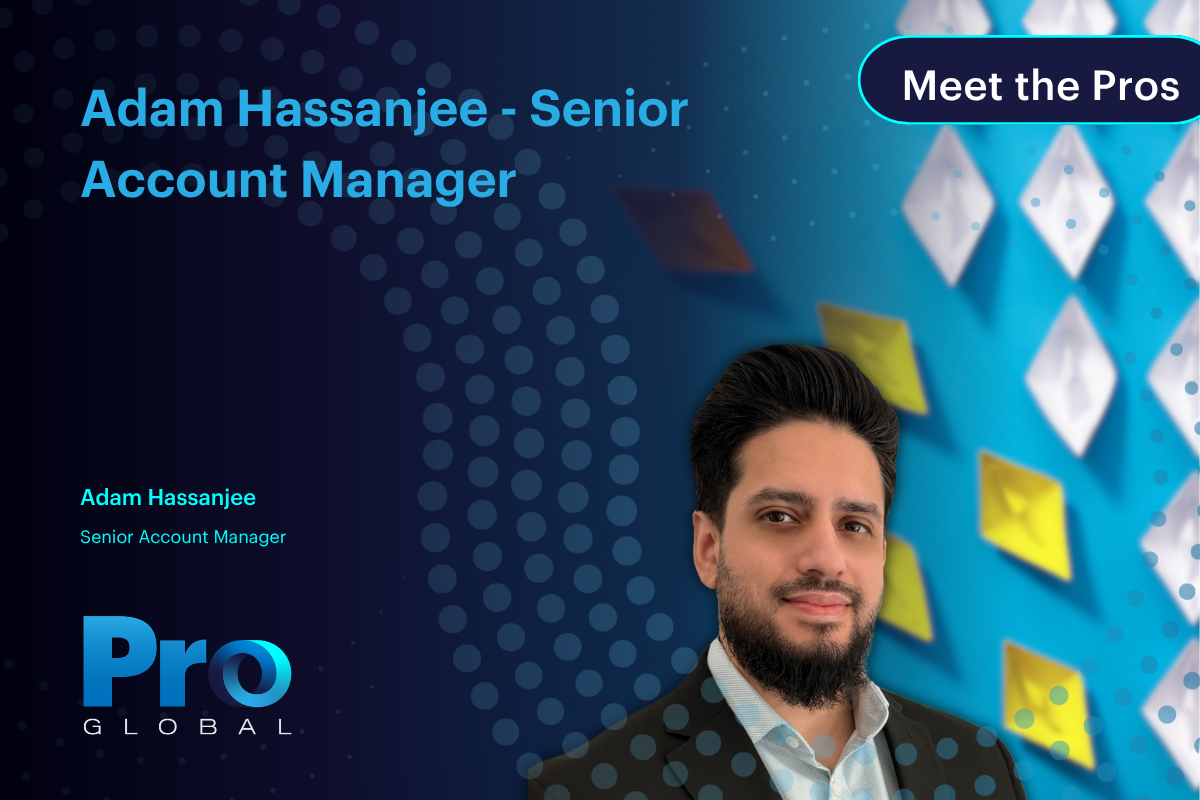

Meet our expert
Name: Adam Hassanjee
Job title: Senior Account Manager
Get in touch
To speak to the Pro Global team please feel free to reach out to us at:


Lysander PR
To contact our PR team directly please use the link below

At our core, we’re a team of specialist insurance experts who can simplify and transform complex and speciality insurance operations.
HOW WE HELPWe can help you transform your operational effectiveness, implement effective changes, outsource and scale your operations, audit your organisational compliance and enable your MGA.
OUR SERVICESPro is an expanding global business supporting the insurance industry. We don’t sell insurance ourselves - insurers come to us to help them transform, outsource, or audit their specialist insurance operations.
JOIN USPro Global is one of the leading providers of outsourced services and solutions to the London Market. Our depth of experience can be found across our media section.
News & MediaDelegated authority has become one of the most important and fastest-growing channels in the insurance market, particularly across Lloyd’s and the global company market. But with that growth comes a familiar challenge: data, data everywhere, and not always in a format that’s timely, consistent, or even usable. As volumes increase and oversight requirements intensify, the need for high-quality data, strong governance, and scalable operational support has never been greater.
At Pro Global, Adam Hassanjee sits right at the heart of this shift. Having built his career across delegated underwriting, bordereaux management, and technical accounting, he now works closely with clients to help them navigate an increasingly complex delegated authority landscape, one that is moving well beyond pure processing towards a more integrated, end-to-end approach.
We spoke to Adam about how client expectations are changing, where the biggest pressure points lie, and what the future holds for delegated authority.
Delegated authority is a critical growth channel: what do clients need most from partners like Pro today to operate effectively?
At its core, clients are looking for a partner who can support the full delegated lifecycle, not just one part of it. Historically, the focus was very much on processing, getting bordereaux in, reconciling the numbers, and keeping things moving.
Now, it’s much broader. Clients need support from onboarding and due diligence through to ongoing oversight, audit, and reporting. As their delegated portfolios grow, they also need flexibility, whether that’s handling increased volumes, supporting new lines of business, or stepping in to manage backlogs.
For us, it’s about combining technical expertise with that scalability, and really acting as an extension of our clients’ delegated authority teams.
Where are the biggest pressure points in delegated authority today, particularly around bordereaux, data, and oversight?
Data is still the biggest challenge across the market. It’s not just about accuracy, it’s about timeliness, completeness, and consistency.
We regularly see delays in receiving bordereaux, missing or incomplete data, and different formats coming through from MGAs and coverholders. Even when the data is there, it’s not always in a format that clients can easily use.
At the same time, the growth in delegated authority is increasing volumes and complexity, which puts pressure on internal teams. There’s also a talent challenge, these are specialised skills, and they’re not easy to find or retain.
All of that means clients need strong processes, proper oversight, and the ability to quickly identify and resolve issues when they arise.
How has Pro’s support for delegated authority clients evolved in recent years?
There’s been a clear shift from a processing-led model to a much more end-to-end delegated authority offering.
Bordereaux management and technical accounting are still core, but we now support clients across onboarding, due diligence, governance, and audit. That allows us to spot and resolve issues much earlier in the lifecycle, rather than reacting once data reaches the processing stage.
We’re also much more closely aligned with technology and digital services than we were a few years ago. Clients want joined-up solutions, not just people or systems, but a combination of both that delivers real visibility and control.
A lot of this change is being driven by increased regulatory scrutiny, higher expectations around data quality, and the continued growth of the delegated authority market itself.
What role do data quality and technology now play in delivering successful delegated authority outcomes?
They’re absolutely central. Delegated authority doesn’t operate in isolation, that data feeds into exposure management, actuarial modelling, and financial reporting. If it’s not right, the impact is felt across the business.
Technology is helping to address some of these challenges, particularly when it comes to data ingestion, workflow, and reporting. We’re also seeing more automation and AI being used to standardise bordereaux and reduce manual handling.
That said, technology on its own isn’t enough. You still need subject matter expertise to sense-check the outputs, ensure quality, and make sure the data is actually useful.
It’s really about combining the two, using technology to drive efficiency, while maintaining the right level of oversight and control.
Looking ahead, how do you see delegated authority evolving, and what will define best-in-class support?
We’re likely to see much greater integration across the value chain, from MGAs and coverholders through to brokers and carriers, with more consistent, standardised data flowing through the market.
Technology, automation, and AI will continue to improve efficiency and scalability, allowing clients to write more business with leaner teams. But at the same time, governance and oversight will become even more important.
Best-in-class support will come down to a combination of connectivity, data quality, and expertise. It’s about getting the data right at source, making it usable across the business, and having the right controls in place throughout the lifecycle.
Delegated authority will continue to grow, but those who can turn data into meaningful insight, while maintaining strong operational control, will be the ones who really stand out.
Name: Adam Hassanjee
Job title: Senior Account Manager
To speak to the Pro Global team please feel free to reach out to us at:
To contact our PR team directly please use the link below

Please fill out the following form so that we can connect you with the specialists best suited to your enquiry.
By filling in the following form you are agreeing to receive our newsletter and industry relevant communications

 View Previous