Get in touch
To speak to the Pro Global team please feel free to reach out to us at:


Lysander PR
To contact our PR team directly please use the link below

At our core, we’re a team of specialist insurance experts who can simplify and transform complex and speciality insurance operations.
HOW WE HELPWe can help you transform your operational effectiveness, implement effective changes, outsource and scale your operations, audit your organisational compliance and enable your MGA.
OUR SERVICESPro is an expanding global business supporting the insurance industry. We don’t sell insurance ourselves - insurers come to us to help them transform, outsource, or audit their specialist insurance operations.
JOIN USPro Global is one of the leading providers of outsourced services and solutions to the London Market. Our depth of experience can be found across our media section.
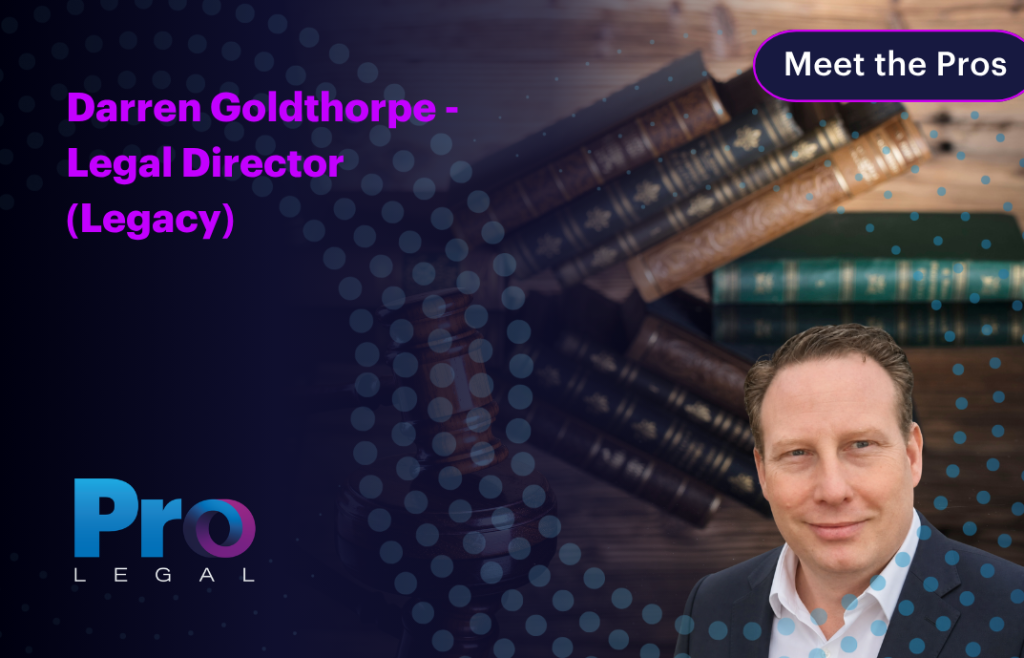
News & MediaDarren Goldthorpe is a solicitor with more than two decades of experience in occupational disease and industrial illness litigation, acting exclusively for defendant insurers, MGAs and self-insured organisations. His practice has spanned the full range of exposure-based claims – noise-induced hearing loss, HAVS, asbestos-related disease, occupational asthma and WRULD – across both live market and run-off or scheme of arrangement contexts. He has held senior roles at DAC Beachcroft, BC Legal and Kennedys, where he developed particular expertise in high-volume portfolio strategy, claims handling methodology and the management of complex legacy liabilities.
Throughout his career, Darren has combined legal practice with a sustained interest in how technology can improve claims outcomes. He has been involved in the development of analytical and case management tools at each stage of his career – from early software for NIHL probability assessment and insurer reserving, through to AI-assisted approaches to medicolegal evidence analysis and litigation management. As Legal Director – Legacy at Pro Legal, he brings that combination of technical specialism and innovation focus to the development of Pro Legal’s legacy and run-off proposition.
Can you please tell us a bit about your background and your current role, including what initially drew you into the insurance sector, your main responsibilities, and key areas of interest and expertise.
I started in 1992 as an Office Junior at a small firm in Barnsley, working my way up the career ladder to Legal Executive and then Solicitor, before spending 30 years in general personal injury and occupational disease litigation, during which time I gained experience as a Claimant lawyer.
I have acted exclusively for defendants since 2007, acting for insurers, MGAs, and self-insured organisations. I’ve worked across Noise-Induced Hearing Loss (NIHL), Hand-Arm Vibration Syndrome (HAVS), asbestos, occupational asthma, and Work-Related Upper Limb Disorder (WRULD) – of which cases have included complex portfolios and run-off schemes. Gaining experience at various firms has helped me build experience in how to handle these claims at scale.
Occupational disease is genuinely intricate work, and I’ve always been fascinated by the technical side – which is partly what drew me into this line of work. Throughout my career I’ve been involved in building various tools, from calculators and case management systems, right through to analytical software.
Tools like this are vital because the law is only half the battle. The other half is process and evidence. You need both to get things right.
Which key trends are of the most importance in the current legal landscape? How do you feel they are shaping your area of expertise?
There are a few things moving at once. Firstly, the NIHL epidemic has subsided, which is good news in one sense; we’ve genuinely reduced the volume. But what that’s left us with is the tail-end work: legacy claims, complex causation arguments, disputes with claimants’ experts. You can’t win those on volume tactics anymore. You need precision.
Secondly, regulation and compliance are tightening, including GDPR, ICO registration, and data handling standards. When handling medical evidence and audiograms, you have to treat these updates seriously.
The third thing to mention is AI and automation. This is the big one for me – as these tools are actually useful now. Compared to what they offered five years ago, you can now run a batch of audiograms through vision models and extract numeric data in record time; allegations can be extracted and processed against data models; and real world outcomes can be mapped as a guide for an agent.
All this changes what’s possible in legacy claims handling. The question isn’t “should we use this?” anymore – it’s “how do we implement it without creating compliance holes?”
The recent Abbott v Ministry of Defence (MoD) hearing loss judgment has generated significant discussion across the market. What do you see as the key implications for insurers and legacy claims handling, and what trends do you expect to shape these claims over the next year?
Abbott v MoD clarified that revised Military Noise-Induced Hearing Loss (rM-NIHL) only applies to military cases. This is helpful in that it narrows the field. For non-military occupational NIHL, the Coles, Lutman, and Buffin (CLB) Guidelines remains the operative framework. This is what we’re building around.
The broader implication is that legacy claims are increasingly about precision. Abbott sets a high bar for evidence. You can’t rely on rough probabilities or soft causation arguments. You need clean audio data, proper baseline methodology, and documented exposure history. That sounds onerous, but it’s actually good news for defendants, and it’s forced a shift towards better claims handling methodology generally.
I expect over the next year to see more focus on audio data quality, more challenges to claimants’ expert evidence on methodological grounds, and genuinely more use of analytical tools to identify which claims are defensible and which aren’t. The firms which have invested in that infrastructure will have an advantage in this area.
AI and automation are becoming increasingly important in claims management. How is this changing the handling of legacy and industrial disease claims, and where do you see the biggest opportunities for Pro Legal to use this technology?
The real opportunity is in evidence analysis, decision support, and portfolio-level analysis – and using technology to create platforms that work with us rather than against us.
The bigger play for this is integration and usability. Legacy claims are held across multiple systems. The real value is pulling all that together, getting a single view of exposure, and then applying analytical tools to that. That’s harder than it sounds, but it’s where the efficiency gains are.
In your opinion, what would you like to see change and/or improve throughout the sector? What are your ambitions with regard to your role at Pro Legal?
The sector needs to be less defensive about technology. While there are good reasons to keep to the “old ways” for certain practices, some of it is just inertia. If you can handle claims better, faster, and with lower risk using the right tools, why wouldn’t you? As mentioned earlier, it is about making technology work for us.
This is where my ambitions for Pro Legal begin: I’m aiming to build a legacy claims operation where we have clear visibility of exposure, where we’re making defensible decisions, and where we’re using technology as a multiplier rather than a crutch. That means decent systems, decent processes, and people who understand both the law and the evidence.
Get in touch with the Pro Legal Solutions Team
To speak to the Pro Global team please feel free to reach out to us at:
To contact our PR team directly please use the link below

Please fill out the following form so that we can connect you with the specialists best suited to your enquiry.
By filling in the following form you are agreeing to receive our newsletter and industry relevant communications

 View Previous