Get in touch
To speak to the Pro Global team please feel free to reach out to us at:


Lysander PR
To contact our PR team directly please use the link below

At our core, we’re a team of specialist insurance experts who can simplify and transform complex and speciality insurance operations.
HOW WE HELPWe can help you transform your operational effectiveness, implement effective changes, outsource and scale your operations, audit your organisational compliance and enable your MGA.
OUR SERVICESPro is an expanding global business supporting the insurance industry. We don’t sell insurance ourselves - insurers come to us to help them transform, outsource, or audit their specialist insurance operations.
JOIN USPro Global is one of the leading providers of outsourced services and solutions to the London Market. Our depth of experience can be found across our media section.
News & MediaA product can pass approval, meet its sales targets and generate few complaints – and still leave customers poorly served. For insurance businesses, effective oversight means understanding whether products reach the right customers, deliver fair value and perform as intended when a claim arises. Complaints provide a critical test of that promise.
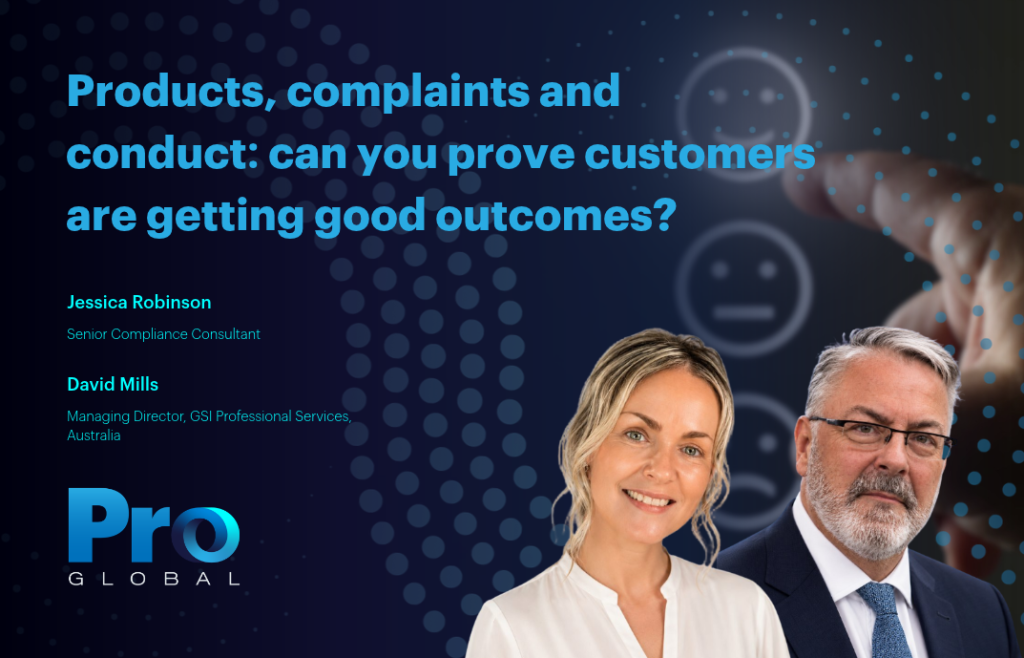
These were the central themes of Pro Global’s 14 October fireside chat webinar discussion, featuring David Mills, Head of Region for Australia, and Jessica Robinson, Senior Compliance Consultant: A dynamic discussion that brought together UK and Australian perspectives on product governance, complaints and conduct. Here are the key takeaways:
Product governance needs to follow what happens after approval: who buys the cover, what they understand, what they pay and how the policy responds when they need it.
Jessica’s practical advice was clear: “Pick a product, follow it end to end.”
That means examining the target market, wording, sales journey, remuneration, claims and complaints together. Does the product reach its intended customers? Are exclusions understood? Does the claims experience support the promise made at sale?
Looking across the entire journey can expose gaps that individual teams may miss when reviewing their own responsibilities in isolation. It also challenges firms to consider whether the product is delivering the outcomes originally intended.
A complaint received by the claims team may have its roots elsewhere. Repeated disputes about an exclusion, for example, could point to a wording problem, unsuitable distribution or a mismatch between the product and its target market.
As Jessica explained: “I never really take one complaint in isolation.”
The challenge is to establish how widely the issue extends. Could it affect other customers, products or coverholders? Are similar complaints being categorised differently across the business?
Effective root cause analysis should go beyond resolving the individual complaint. Firms need to establish whether the underlying issue affects other customers, products or distribution arrangements, and act before further harm occurs.
3. Feed complaints findings back into the product
David’s Australian experience highlighted the importance of learning from complaints and external dispute decisions.
His challenge to businesses was straightforward: “How are we going to stop this from occurring again?”
Identifying the root cause is only the starting point. Findings need to influence product reviews, underwriting guidelines, policy wordings and staff training where appropriate,
The real test is whether lessons from complaints lead to changes that prevent the same problems recurring. Effective challenge requires sufficient independence, clear responsibilities and people equipped to reconsider the customer’s experience.
In the Lloyd’s and London markets, managing agents may be several steps removed from the customer. That makes reliable information from coverholders and third-party claims administrators essential.
Jessica described the gap firms can encounter: “The framework looks great, but the MI that comes on the back of that isn’t actually telling the full story.”
An issue identified at on coverholder may indicate a wider problem across the portfolio. Firms should be able to identify emerging trends across delegated arrangements, rather than assessing each coverholder in isolation.
But collecting MI is not enough. Firms need to challenge its completeness, accuracy, and consistency, and understand what it reveals about customer outcomes. This is particularly important where multiple parties are involves int he distributions and claims journey.
5. Turn conduct findings into practical improvements
Product and conduct issues often cross underwriting, distribution, claims, complaints and compliance. Remediation needs to follow those connections, with clear ownership and checks that changes reach the relevant teams.
David summed up the practical ambition: “We don’t want compliance to get in the way. This needs to be seamless.”
A proportionate response might involve clearer wording, a revised escalation route, better training or stronger review of claims decisions. The aim is to address the cause and improve the customer experience.
That requires follow-through. As David emphasised, firms need to “go back and monitor it on a regular basis.”
A completed action tracker records activity. Evidence of better customer outcomes shows whether that activity worked.
Senior management should be able to see not only what issues have been identified and what actions have been completed, but also whether those actions have delivered improvements.
Thant means looking at the evidence over time, have complaints reduced, are claims outcomes improving, are products reaching their intended markets and have identified weaknesses been addressed?
Where evidence is incomplete or difficult to obtain, firms should question whether their existing governance and reporting arrangements are sufficiently effective to identify emerging harm.
Good product governance shows up when customers need their cover: in clear wordings, fair claims decisions and complaints that lead to meaningful change.
For boards and senior leaders, the challenge is to connect those experiences across products, teams and delegated partners – and act when the evidence reveals harm.
Start with one product. Follow the customer journey. Challenge what the data tells you. Then check that the improvements made a difference.
Get in touch to discuss further: getintouch@pro-global.com
To speak to the Pro Global team please feel free to reach out to us at:
To contact our PR team directly please use the link below

Please fill out the following form so that we can connect you with the specialists best suited to your enquiry.
By filling in the following form you are agreeing to receive our newsletter and industry relevant communications

 View Previous